‘Artist’ Collection Truly a Model Exhibition
By Wesley Pulkka
For the Journal
Albuquerque art maven Ralph Greene is having a 16-piece solo paintings show at Exhibit 208 through March 1. His exhibition explores the historically familiar “Artist and the Model” theme.
Greene is a postmodernist abstract expressionist who revisits an arena already explored by several modernists including Pablo Picasso, Willem De Kooning, George McNeil, Francis Bacon, and Henri Matisse.
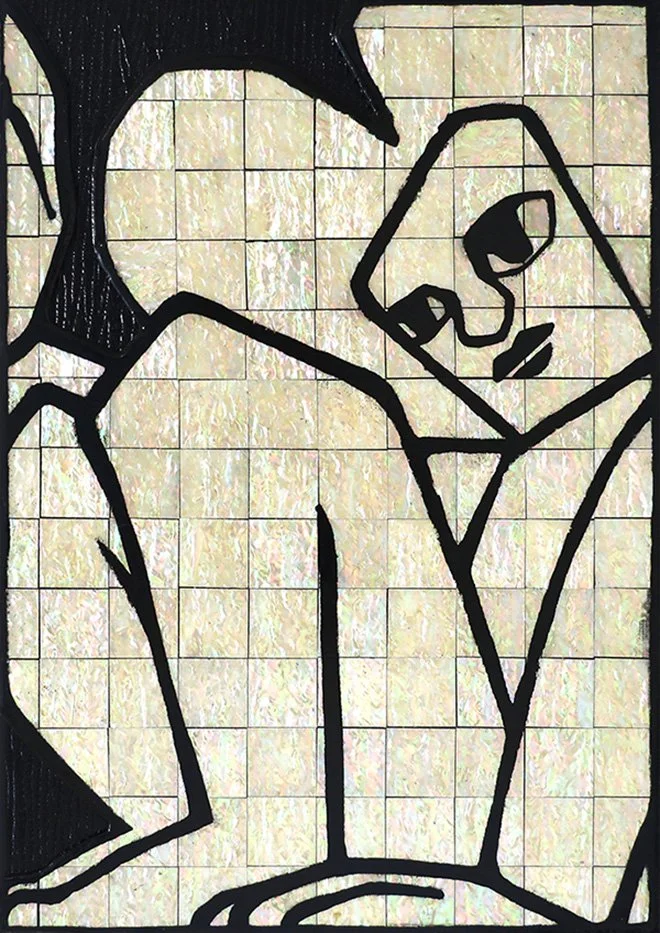
My favorite Ralph Greene Painting is “Daddy’s Rocker,” which contains stylistic elements from Matisse Picasso and De Kooning.
To arrive at “Daddy’s Rocker” Greene borrowed a touch of anger toward women from De Kooning’s “Woman” series from the 1950s and added a sprinkle of controlled distortion from Picasso’s “Girl at the Mirror” and many drawings and sculptures of nudes by Matisse.
The surface is replete with expressionistic brushwork, gobs of raw color and the rough tactile quality of real life in the city.
Greene brought to the painting his own experiences, Male artists have been accused over the years of exploiting women in pursuit if ideal form. Early European academic artists like Michelangelo studied the male nude to understand the muscular structure. The soft curves offered by female nudes had no appeal to Michelangelo, who pursued Greek and Roman classicism.
It can be argued that1 9th century artists as Bouguereau did, in fact, exploit very young women to titillate his way to fame and fortune. In Picasso’s more explicit prints the relationship between artist and model is blatantly sexual.
However, in Greene’s case, a search for an understanding of the feminine within himself is an equally compelling argument for the use of the female form.
Greene distorts, exaggerates and otherwise pummels the nude as a way of dissecting his own feminine aspect. He vigorously applies paint straight out of the tube and keeps his brush in constant motion. The surface becomes a circus arena where wildness and abandon are welcomed only to be brought under control by Greene as ringmaster.
Among these works are elegant passages, violent slashes, and piles of hues that accumulate in certain areas like wind-blown leaves. These paintings exude passion, violence, high energy, love of paint and a need to use acerbic color as means of expressing anxiety, fear, and uncertainty.
They easily express out the contemporary dilemma of terrorism, runaway resource consumption, corporate greed, the threat of open warfare and a staggering economy. Greene’s women make a wonderful metaphor for Mother Earth under assault.
In “Rose,” a pastel on paper, Greene presents a Picasso-like nude with flowers that are pure Matisse. In the background is a fragmented pink nude that could have evolved from Bacon’s strange view of the world.
Though they may be inspired by predecessors, “Daddy’s Rocker” and “Rose” remain Greene’s unique expression. They are not appropriated images or in any way a copy of someone else’s composition.
In ”Wing Stuck, 1994,” Greene explores the theme of “Nemesis” first examined by Albert Durer during the 16th century. It was the ungainly female nude in “Nemesis” that chronicled Durer’s move away from a geometric formalized view of beauty toward a more expressive acceptance of flawed form and distortion.
Greene makes no pretense of idealized beauty while at the same moment capturing essential forms that as a whole manifest a redefinition of idealism. Greene studied painting in New York with George McNeil during the early 1960s and went on to achieve a tenured art faculty position before moving to New Mexico more than 10 years ago.
His solo show at Exhibit 208 is a homecoming on many levels. The gallery was once owned by Greene, who used his role as a gallery director to uncover New Mexico talent with great aplomb.
Greene also imported shows from New York including a solo exhibit of McNeil’s paintings shortly before the artist’s death.
Greene is, after all, a New York artist who decided to offer his energies to New Mexico. He divides his time between his studio and art history classes at Albuquerque Technical Vocational Institute.
His paintings reflect Big Apple aesthetics but have been enchanted by his new home.